Intelligence analysis is fundamentally about understanding connections, but those connections are not always easy to see when information is fragmented across multiple systems and sources.
People, organisations, locations, assets, and events form evolving, growing networks. Understanding those networks is critical to identifying threats, assessing risk, and making informed decisions.
In practice, those connections are scattered across siloed systems, multiple data formats, and different investigations and cases. Intelligence teams lose time reconstructing links that should already be visible – a manual effort that slows analysis, weakens confidence, and delays action when it’s needed most.
Graph-powered intelligence analysis addresses this gap. By modelling data as nodes and relationships, graphs make connections explicit and allow teams to explore networks directly. Graph-powered intelligence supports faster analysis, deeper context, and clearer reasoning across the lifecycle.
This blog post outlines the core challenges facing intelligence teams and explains how GraphAware Hume applies a graph-powered approach to support effective, explainable intelligence analysis.
What challenges do intelligence teams face?
- Fragmented data: Intelligence data is rarely held in one place. Teams need to search across disconnected sources to build a connected intelligence picture. Valuable time is lost locating and manually piecing information together rather than analysing it.
- Siloed analytical tooling capabilities: There’s no single tool used by everyone for everything. Analysis capabilities are spread across multiple platforms for search, link analysis, mapping, timelines, and reporting. This fragments insight, complicates collaboration, and makes it difficult to maintain a shared understanding as cases evolve.
- Relational stores for network analysis: Relational databases aren’t designed or optimised for deep, multi-hop analysis. While they handle simple queries well, performance degrades as teams ask more complex questions.
Many intelligence tools rely on relational or document stores with a graph visualisation layered on top. These systems can look effective in demos, but under operational load, they struggle to answer real investigative questions at speed and scale. - Ad-hoc requirements: Investigations rarely follow a fixed path. As understanding develops, teams face new questions, hypotheses, and lines of enquiry. In many systems, changing direction means rebuilding models, reconnecting data, or restarting analysis altogether, stalling momentum.
- Manual construction: Across the intelligence lifecycle, teams rely heavily on manual steps to assemble, update, and test their understanding of a case. Relationships must often be built, validated, and refined manually, repeating the same tasks as new information arrives. This slows analysis, introduces inconsistency, and limits how easily teams can scale or reuse insight across cases.
- Enormous data volumes and variety: Intelligence teams work with growing volumes of heterogeneous data, from structured records to documents, communications, imagery, and extracted entities. As sources and formats multiply, it becomes harder to retain context and see how information connects across the whole intelligence picture. Valuable signals risk being buried as complexity increases.
The underlying cause: systems not designed for networks
These six challenges share a common root cause: Most intelligence analysis systems weren’t built to handle networks at scale.
They’re designed around records and cases, meaning connections between people, events, and assets are constructed later, inferred indirectly, or pieced together manually. As investigations grow in scale and complexity, this approach breaks down.
Graph-powered intelligence analysis puts relationships at the core of the analysis model. Entities and events are connected as a curated knowledge graph the moment data is added, so analysts can see how things relate straight away, rather than having to piece it together later.
This changes how intelligence work gets done. Manual link building gives way to direct network exploration. Teams can go deeper without losing speed, and context stays intact even as data volumes increase.
GraphAware Hume applies this graph-first approach to real intelligence workflows, combining a graph-native foundation with tools designed for how analysts actually work.
Solving intelligence analysis challenges with GraphAware Hume
GraphAware Hume is built around a simple idea: if intelligence work is about understanding relationships, then the tooling should reflect that from the start.
Rather than forcing analysts to manually assemble networks from disconnected tools, GraphAware Hume uses graph technology to make relationships visible, explorable, and explainable in everyday analysis.
Fragmented data
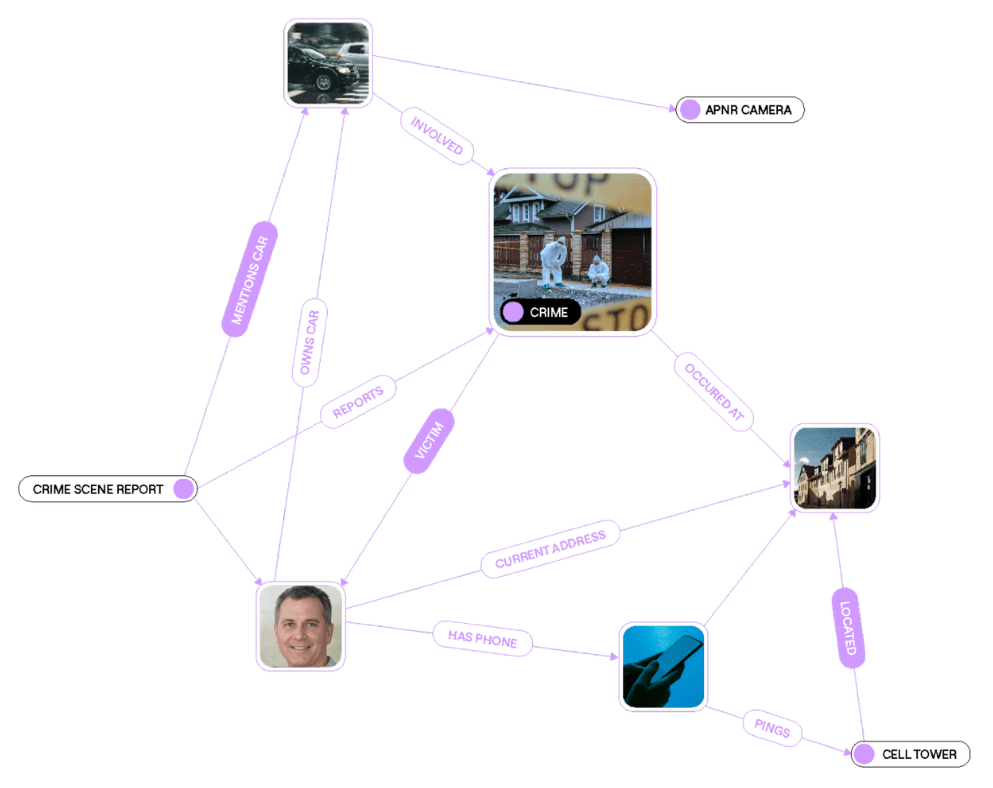
GraphAware Hume brings intelligence data together into a single connected view. People, organisations, locations, assets, and events are linked as data is ingested, rather than sitting in separate systems.
Analysts no longer need to jump between tools, files, and spreadsheets to piece together their intelligence picture. They start from a holistic view and explore connections directly as their understanding develops.
Outcome: Less time spent searching, fewer missed connections, and a clearer picture from the outset.
Siloed analytical tooling capabilities
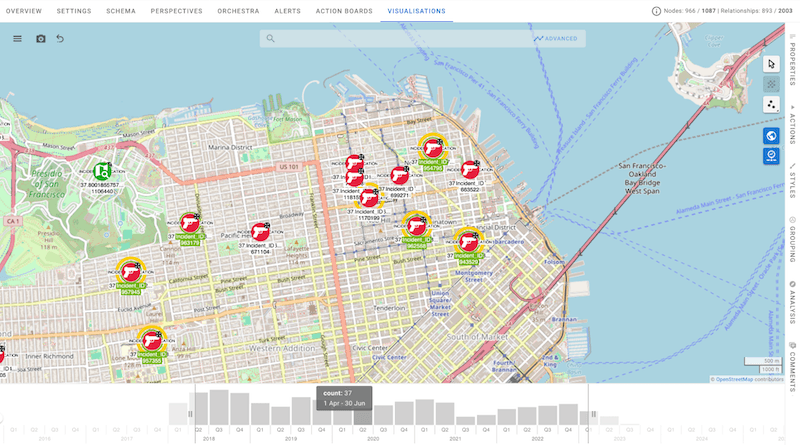
GraphAware Hume supports multiple types of analysis in one place. This means that search, link exploration, timelines, maps, and network views all share the same underlying data.
Because everything is connected behind the scenes, teams don’t lose context when switching between views or collaborating with others. Everyone works from the same understanding, even as cases evolve.
Outcome: Stronger collaboration, fewer handovers, and shared understanding as analysis evolves.
Relational stores for network analysis
GraphAware Hume is built on a powerful graph database, designed specifically to ingest, store and query complex connected data. Relationships aren’t calculated later or reconstructed manually. They are first-class citizens of the data model, enabling analysts to quickly explore influence, connectivity, and indirect links at scale.
Outcome: Faster exploration, deeper analysis, and consistent performance as investigations scale.
Ad-hoc requirements
Investigations rarely follow a straight line. New suspects emerge, priorities shift, and the next question rarely matches the last.
GraphAware Hume is designed for that reality. Teams can introduce new data sources, test new hypotheses, and follow new lines of enquiry without redesigning models or rebuilding workflows. Everything remains grounded in the same connected view of intelligence, so changes in direction don’t trigger tedious manual rework.
Outcome: Faster response to new leads and fewer delays when cases shift direction.
Manual construction of analysis
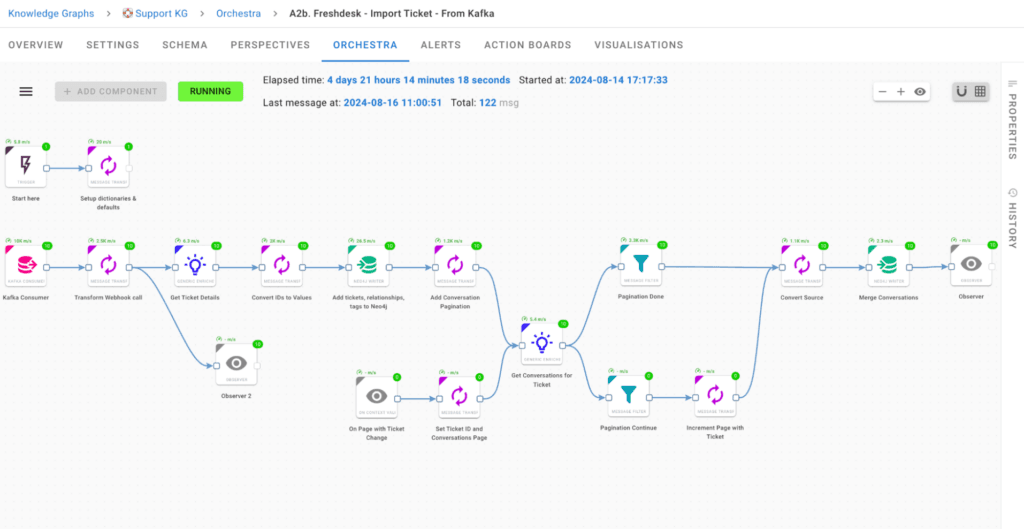
GraphAware Hume automates repetitive analytical tasks while keeping teams in control. Teams can run prebuilt queries, add entities to collections, and apply workflows across multiple cases without manually rebuilding networks. Hume Orchestra enables teams to build and run data pipelines that ingest new sources, enrich data, and connect to external APIs.
In many intelligence tools, link analysis happens manually. Analysts must identify entities, draw connections, and reconstruct a network view whenever the question changes.
GraphAware Hume flips that model. Analysts don’t manually construct the graph as they go. They start with a connected view of intelligence and simply query it. Instead of rebuilding a new canvas for each scenario, teams reuse the same underlying graph and ask new questions against it.
Outcome: Less time spent assembling networks, more time spent interpreting intelligence, and analysis that’s faster, more consistent, and easier to repeat across cases.
Enormous data volumes and variety
GraphAware Hume allows data from many sources and formats to be brought together in a single connected knowledge graph. Structured records, documents, communications, and other investigative data can all be linked, keeping context visible across the intelligence picture even as data volumes grow.
Outcome: Clearer insights from complex, multi-format data, with relationships preserved so teams can see how information connects across the intelligence picture.
Graph-powered intelligence proves its value when applied to real problems. See how organisations are using GraphAware Hume in practice:
- Transforming policing in Western Australia through connected intelligence
- How a cybersecurity agency strengthened network analysis across complex datasets
Bring connected intelligence to your workflow
If you’re exploring how graph-powered intelligence analysis could support your own work, a guided walkthrough of GraphAware Hume can help show how this approach will accelerate your day-to-day workflows.
Get in touch