Connected intelligence across every source
Unify fragmented data as a connected intelligence picture for faster, deeper analysis.
Book a demo
Unify fragmented data as a connected intelligence picture for faster, deeper analysis.
Book a demo
When a child goes missing, every minute counts. With GraphAware Hume, we don’t have to start from scratch every time an event like this is reported. We can act fast and save lives.— Law Enforcement Agency, Data Science Lead
The system has instantaneously produced results that would have taken a human a significant amount of time to conduct manual analysis, and in some cases, identified links that would have unlikely been identified at all.— Western Australia Police Force, Senior Tactical Intelligence Analyst
Graph-powered intelligence analysis for law enforcement
GraphAware Hume unifies fragmented data, accelerating criminal investigation workflows
Criminal investigations rarely begin with the full picture.
GraphAware Hume connects fragmented intelligence into a single view, helping analysts uncover hidden relationships, understand criminal networks and progress investigations with greater speed and confidence.
Modern investigations are about understanding connections between people, organisations, locations, assets, and events.
But most law enforcement analysts are still working with lists, tables, spreadsheets, and relational technology designed for a previous era.
Siloed systems and rigid data models force slow, fragmented thinking when the problem is a complex, living network.
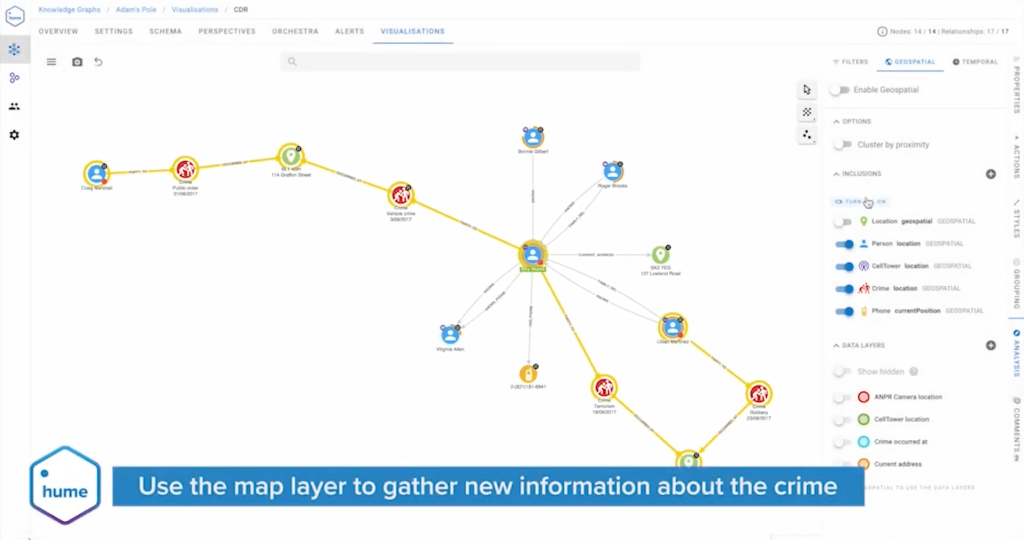
GraphAware Hume creates a connected intelligence picture that makes those relationships immediately accessible, so analysts can stop searching for information and start understanding it.
Bring your fragmented data together as a connected intelligence picture that reflects how analysts think and how criminal activity happens in the real world.

Ask more complex questions and get answers faster. Explore connected intelligence in a way that feels natural, uncovering hidden relationships and revealing new lines of enquiry.
Why organisations choose GraphAware Hume
Built on a graph-native core
As investigations and data complexity grows, most analysis tools grind to a halt.
GraphAware Hume is different. Built on graph technology at every layer, it creates a connected intelligence picture that gets more powerful as data volumes and complexity grow.
Limits on the depth and scale of your analysis disappear, letting you answer questions that would otherwise be impossible.

A platform you make your own
GraphAware Hume is designed to adapt to your needs, not force you into fixed ways of working.
You design the pipelines. You define the schema. You configure it for the job that needs to be done. No black boxes. No proprietary logic. No vendor lock-in.
It’s a secure, transparent, and flexible platform you can make your own.

Proven route to intelligence
We’ve refined our approach to bypass traditional integration purgatory.
We prioritise fast time to value, early results, and iterative improvements that build momentum. Analysts are asking real questions and finding answers in data within weeks.
From there, GraphAware Hume grows with your mission as you integrate new sources, refine your models, and deliver lasting value.
Organised crime is resilient because it operates as a network. Arresting one offender or disrupting one incident rarely tells you how the wider organisation works, who enables it or where to intervene next.
Graph-powered criminal intelligence analysis helps investigators:
And move beyond street-level arrests, and focus on the networks behind them.
Recovering criminal assets depends on proving who really controls what. But ownership is deliberately concealed through shell companies, nominee arrangements, intermediaries and layered financial activity designed to frustrate investigators.
Graph-powered criminal intelligence analysis helps investigators:
Develop a clearer picture of ownership and control to support asset tracing and confiscation.
A phone download, call record, or device location dataset rarely reveals much in isolation. Its value comes from connecting it to people, places, events, and other known intelligence.
When CDRs and digital evidence are connected within a wider intelligence graph, relationships and behavioural patterns emerge that are difficult to uncover through isolated analysis alone.
Graph-powered criminal intelligence analysis helps investigators:
Turn digital material into intelligence that supports faster, better-informed investigations.
In major and time-sensitive investigations, the first challenge is often understanding what is already known.
Graph-powered criminal intelligence analysis helps investigators:
Give investigation teams the context they need to act quickly when time matters.
In complex investigations, identifying likely suspects often means searching across multiple siloed data sources to identify connections between people, devices, vehicles, locations, and previous activity.
Graph-powered criminal intelligence analysis helps investigators:
Move from static suspect lists to intelligence-led suspect development.
Criminal activity rarely aligns neatly with organisational or jurisdictional boundaries.
When intelligence is fragmented across agencies and systems, critical context can remain hidden, duplicated, or difficult to access during active investigations.
Graph-powered criminal intelligence analysis helps agencies:
Enable collaborative workflows that improve inter-agency knowledge, strengthen investigative understanding, and support more coordinated responses.

Every investigation generates new intelligence. GraphAware Hume ensures that intelligence becomes part of a growing connected picture rather than remaining trapped inside individual cases.
Discover GraphAware HumeBring structured and unstructured data together into a single environment where every entity, relationship and event contributes to the wider intelligence picture.
Move away from manually drawn graphs. Create an always-current investigation environment, with entities, relationships, and intelligence linked and ready to explore.
Use visual query building with no coding expertise required. Expand on your existing link analysis tooling to get useful intelligence faster.
Discover patterns and relationships with multi-hop connection analysis, and explore them as networks, on maps, or through time.
Set up alerts based on evolving relationships, network behaviour, and graph-derived intelligence patterns to support faster response and proactive investigation.
Set up workflows to distribute insights to various stakeholders seamlessly using Workspaces, snapshots, and annotations.
Enable co-offending network analysis and link prediction using context-rich network data, powered by graph data science.