A van stop. A suspicious warehouse rental. A container flagged at the port. On their own, these incidents seem routine and unconnected. But perhaps they’re part of a growing trend: the illegal importation and distribution of illicit tobacco.
High domestic prices have created a lucrative market for smuggled tobacco products moving from low-tax to high-tax jurisdictions. And it’s a global problem: 50% of tobacco consumed in Australia is sourced illegally, costing $2.7 billion in lost tax revenue each year. UK authorities seized almost 1.2bn illicit cigarettes in 2024-25, and almost one in ten cigarettes consumed in the EU is illicit.
It’s not just a revenue issue. Beyond the economic impact, these operations are closely connected to wider organised crime, including arson attacks, shootings, and human trafficking.
In this article, I’ll show how a graph-powered intelligence analysis gives investigators the clear, connected and contextual view they need to identify key actors, understand distribution patterns, and disrupt the infrastructure behind illicit tobacco networks.
From isolated seizures to a connected intelligence picture
To move beyond case-by-case enforcement, agencies need more than lists and isolated data points. They need to see people, organisations, locations, vehicles, events and financial flows in a single, connected view.
That’s where graph technology comes in.
By bringing together case files, open source intelligence, phone downloads, and any other structured or unstructured data, a graph-led approach lets analysts explore networks, surface patterns and test hypotheses in a way that traditional tools cannot match.
In practical terms, it lets officers and investigators see connections: identifying high-risk actors, locating how and where they operate, associating illicit tobacco with wider criminal infrastructure, and disrupting the network as a whole – not just one seizure at a time.
Let’s take a closer look.
1. Identify: spot the right people and entities early
The first step in countering illicit tobacco networks involves identifying the key actors and entities. Graph-powered intelligence analysis supports this in two ways:
Connecting existing investigations
By bringing together case files, company records, licensing data, etc, in a single graph view, law enforcement can surface connections that would otherwise be impossible to see in isolation. Shared ownership, address patterns, and financial links behind seemingly unrelated entities become immediately visible.
Detecting patterns through population-level analysis
Agencies can apply population‑level risk analysis to find new targets that haven’t yet shown up in investigations.
A sudden drop in a retailer’s tobacco excise payments might be flagged as high risk. But when this anomaly is combined with company records data showing shared directors, unusual changes in ownership, or relationships with other flagged entities, a fuller picture emerges.
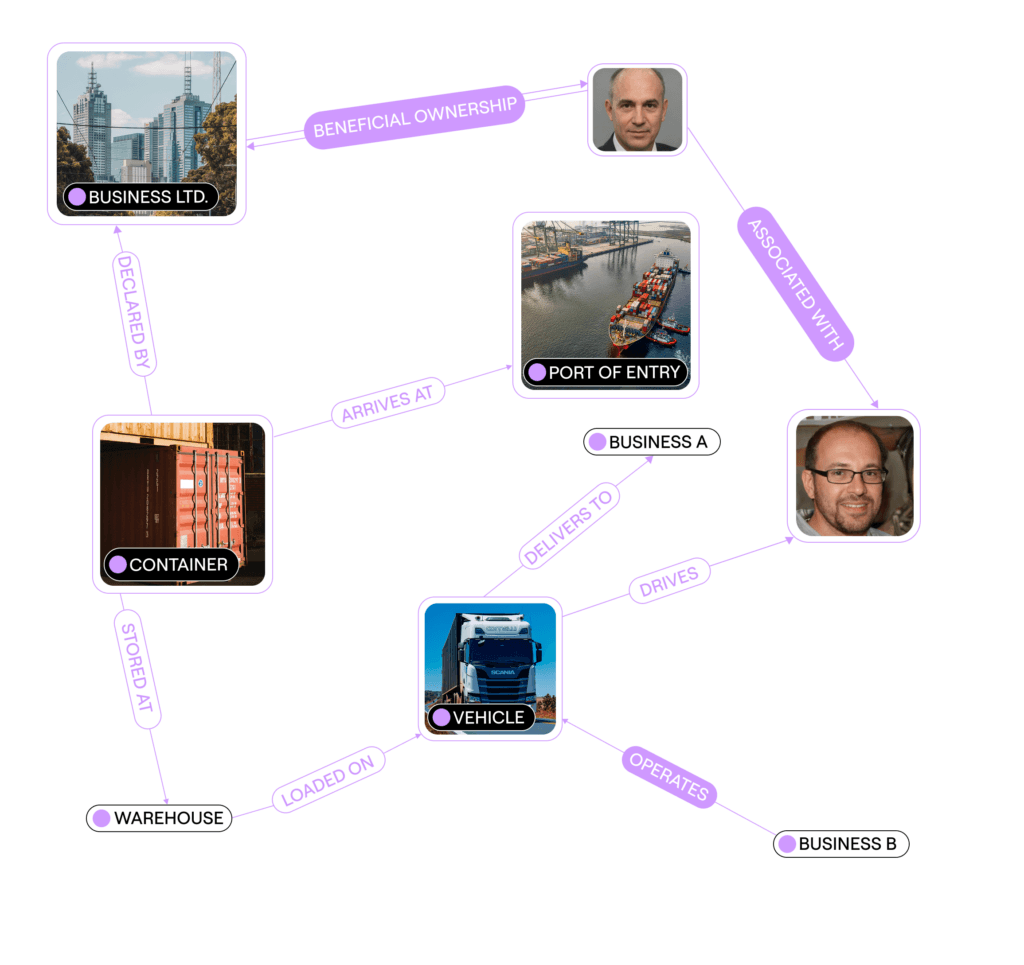
When these signals are combined, analysts get a clearer view and can prioritise the right targets for intelligence gathering before enforcement action is taken.
2. Locate: see where activity happens and how products move
Once high-risk entities are identified, the next step is understanding where they operate.
By enriching the knowledge graph with geographic information – like storage locations, freight routes, retail addresses – analysts can see:
- Clusters of suspicious businesses within specific suburbs or regions
- Distribution patterns that show how illegal products move across state lines
- Logistics routes from the port to the store.
These insights help agencies prioritise enforcement, surveillance, and disruption efforts in the locations where they’ll have the greatest impact.
3. Associate: uncover the broader criminal infrastructure
Illicit tobacco networks don’t work in isolation. They’re often intertwined with wider organised crime activities like money laundering, drug trafficking, human trafficking and tax evasion, all facilitated through complex webs of people, companies, and transactions.
Graph-powered intelligence analysis excels at exposing these connections. making it easy to trace:
- Hidden infrastructure, like shared warehouses and logistics providers
- The financial flows between suppliers and front companies
- Links between offshore entities, domestic operations and their beneficial owners
These associations transform a single illicit tobacco case into a broader, intelligence-led financial crime case.
4. Disrupt: target the network, not the foot soldiers
Armed with the right intelligence on people, places, organisations and movements, enforcement agencies can move decisively to disrupt illicit networks.
It can help them identify the people and entities with the most connections and greatest influence – the key ‘nodes’ sitting at the heart of the network.
Agencies can also identify the ultimate beneficial owners of relevant entities, freezing assets and cutting off the financial incentives that sustain their operations.
By focusing on the network’s structure, rather than just its symptoms, this approach strikes at the core of illicit operations, delivering a lasting impact rather than a temporary setback.
From reactive to strategic enforcement
Illicit tobacco networks are resilient because they operate as connected systems. When agencies limit their view to isolated nodes, enforcement becomes fragmented and reactive, addressing symptoms rather than the underlying structure.
A graph-led approach reveals the full picture.
Sounds familiar?
If your organisation is facing similar challenges, we’d be happy to share how agencies are using graph-powered intelligence to deliver more coordinated, lasting disruption.
Get in touch