
What are graph algorithms?
Graph algorithms are analytical techniques that examine the relationships between entities to answer questions that would be difficult or impossible to solve using traditional data analysis.
Rather than analysing individual records in isolation, graph algorithms analyse the structure of a graph itself. They examine how people, organisations, accounts, devices, locations, events, and other entities are connected, helping analysts uncover patterns, identify influential individuals, detect organised groups, and reveal hidden relationships.
For intelligence analysts, graph algorithms are one of many analytical techniques available during an investigation. Alongside link analysis, timeline analysis, geospatial analysis, and entity resolution, they help analysts make sense of complex, connected information while supporting, not replacing, professional judgement.
When are graph algorithms used?
Most investigations begin with something already known.
A suspect. A company. A mobile phone. A bank account. An address.
The challenge is rarely finding information about that starting point. The challenge is understanding how it connects to everything else.
Graph algorithms help analysts answer questions such as:
- Who appears to coordinate this network?
- Which individuals connect otherwise separate groups?
- Which companies sit between assets and their ultimate beneficial owner?
- Which entities behave similarly to known fraudsters?
- Which hidden relationships deserve further investigation?
Rather than manually following hundreds or thousands of relationships, analysts can use graph algorithms to highlight the parts of an investigation most likely to require closer examination.
Graph algorithms support analyst judgement
Graph algorithms do not determine what happened. They identify patterns that may warrant further investigation.
An unusually central individual is not automatically the organiser of a criminal network. A predicted relationship is not evidence. A detected community is not necessarily an organised crime group.
Instead, graph algorithms help analysts prioritise their work by identifying relationships and structures that may otherwise remain hidden.
The analyst remains responsible for evaluating the evidence, considering the wider context, and reaching defensible conclusions.
This distinction is particularly important in intelligence analysis, where transparency and explainability are essential.
Graph algorithms answer different investigative questions
Different graph algorithms are designed to answer different types of investigative questions.
Who appears to be most influential?
Centrality algorithms identify entities that occupy important positions within a graph.
Depending on the algorithm used, this might mean someone with many connections, someone who bridges otherwise disconnected groups, or someone positioned at the centre of communication or financial flows.
These algorithms can help analysts:
- Prioritise persons of interest
- Identify potential coordinators within organised crime groups
- Understand command structures
- Highlight critical infrastructure or assets
Examples include PageRank, Betweenness Centrality, Degree Centrality, and Closeness Centrality.
Which groups naturally exist within the data?
Community detection algorithms identify clusters of entities that are more closely connected to one another than to the wider graph.
In intelligence analysis, these clusters may represent organised crime groups, fraud rings, terrorist cells, or other operational networks. In commercial investigations, they may represent customer segments or supplier ecosystems.
Community detection helps analysts understand how large investigations are structured before examining individual entities in detail.
Common algorithms include Louvain and Leiden.
How are two entities connected?
Pathfinding algorithms calculate the routes between entities.
Rather than simply showing that two people are connected, they reveal how they are connected, highlighting the intermediate people, companies, accounts, or events linking them together.
This can support investigations into:
- Beneficial ownership
- Money laundering
- Organised crime
- Financial crime
- Supply chain risk
Common algorithms include Shortest Path and Dijkstra’s algorithm.
Which entities behave similarly?
Similarity algorithms identify entities that share similar characteristics or relationship patterns.
For example, they may identify companies with similar ownership structures, customers with similar purchasing behaviour, or accounts exhibiting similar transaction patterns.
In investigations, similarity algorithms can help identify entities that deserve further attention because they resemble previously identified persons of interest.
Examples include Jaccard Similarity, Cosine Similarity, and Node Similarity.
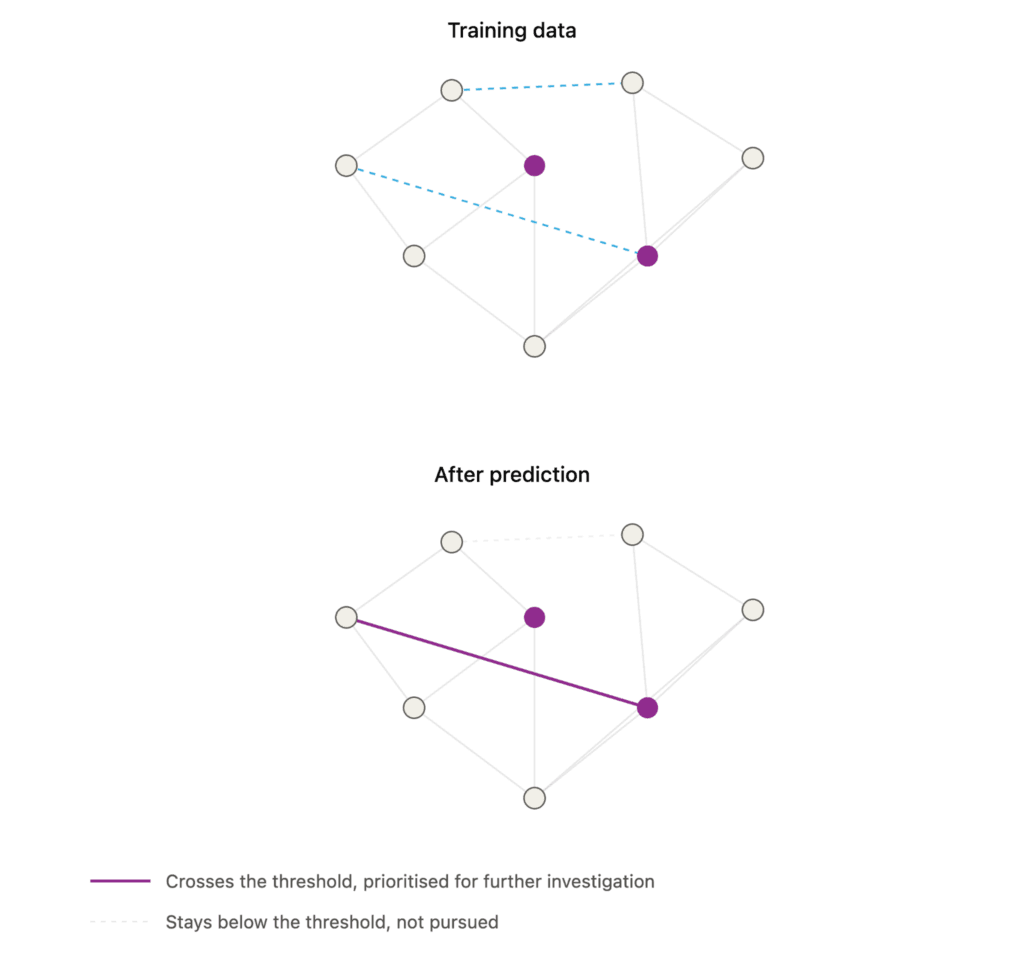
Which relationships might exist but have not yet been observed?
Link prediction estimates the likelihood that two entities should be connected, even when no direct relationship currently exists in the available data.
This doesn’t create evidence of a relationship.
Instead, it generates investigative hypotheses that analysts can test using additional information.
Link prediction is commonly used in fraud detection, cybersecurity, criminal intelligence, and recommendation systems, often alongside machine learning techniques.
Graph algorithms are not the same as graph visualisation
Graph visualisation and graph algorithms are closely related, but they serve different purposes.
Graph visualisation helps analysts explore connected information visually. It supports human reasoning by allowing investigators to navigate relationships, identify unusual structures, and build an understanding of the data.
Graph algorithms automate parts of that analytical process by measuring, ranking, grouping, or predicting relationships across the graph.
In practice, analysts often move between both approaches throughout an investigation. An algorithm may highlight an influential individual or suspicious cluster, which the analyst then explores visually alongside timelines, maps, documents, and other evidence.
Graph algorithms are not graph machine learning
Graph algorithms analyse the relationships that already exist within a graph.
Graph machine learning goes a step further by learning patterns from graph data to make predictions or classifications.
Many modern analytical platforms combine both approaches. Traditional graph algorithms remain valuable for explainable investigation, while graph machine learning can assist with tasks such as link prediction, risk scoring, or anomaly detection.
Choosing the right approach depends on the investigative question rather than the technology itself.
Common applications of graph algorithms
Graph algorithms are used wherever understanding relationships is essential.
Intelligence analysis and law enforcement
Graph algorithms help analysts identify organised crime groups, prioritise persons of interest, analyse communications, investigate hostile networks, and understand how events, people, and organisations relate to one another.
Financial crime
Financial institutions use graph algorithms to investigate money laundering, identify fraud rings, analyse transaction networks, uncover beneficial ownership structures, and strengthen anti-money laundering investigations.
National security
Security and intelligence organisations use graph algorithms to understand hostile networks, analyse communications, identify key actors, and support threat assessments.
Tax and revenue authorities
Graph algorithms help investigators uncover hidden ownership structures, identify tax evasion schemes, and analyse relationships between companies, trusts, directors, and assets across multiple jurisdictions.
How GraphAware Hume supports graph algorithms
Graph algorithms deliver the greatest value when they become part of an analyst’s normal investigative workflow rather than a separate technical exercise.
GraphAware Hume enables analysts to combine graph algorithms with graph visualisation, timeline analysis, geospatial analysis, entity resolution, document intelligence, and AI-assisted investigation within a single workspace.
An analyst might begin by resolving duplicate entities from multiple data sources, use community detection to identify potential organised groups, investigate those groups visually, examine how activity evolved over time, explore movement geographically, and use explainable AI to interrogate supporting documents without losing sight of the underlying evidence.
Throughout the investigation, provenance is preserved so analysts can understand where information originated and justify the conclusions they reach.
Rather than replacing analyst judgement, GraphAware Hume helps analysts work more efficiently while maintaining transparency, explainability, and confidence in their findings.
FAQs
What is a graph algorithm?
A graph algorithm is an analytical technique that examines the relationships between connected entities to identify patterns, calculate paths, detect communities, measure influence, or predict potential relationships.
What are graph algorithms used for?
Graph algorithms are used across intelligence analysis, law enforcement, financial crime, cybersecurity, tax investigations, supply chain analysis, and many other domains where understanding relationships is critical.
What is the difference between graph algorithms and graph analytics?
Graph algorithms are the individual analytical methods used to analyse graphs, such as centrality or community detection. Graph analytics is the broader discipline of applying those algorithms, alongside visualisation and other analytical techniques, to answer real-world questions.
Do graph algorithms require a graph database?
No. Graph algorithms can be implemented using different technologies. However, graph databases are designed to store and traverse highly connected information efficiently, making them particularly well suited to running graph algorithms at scale.
What is the difference between graph algorithms and link analysis?
Link analysis is an investigative technique used to examine relationships between entities. Graph algorithms complement link analysis by automatically identifying patterns, ranking entities, detecting communities, or revealing hidden relationships that analysts can then investigate further.