“When a child goes missing, every minute counts. With Hume, we don’t have to start from scratch every time an event like this is reported. Our data is available and ready to be analysed. We can act fast and save lives. Data Science Lead – Government agency”
When solving a crime, the answer is usually hidden in data. That’s why a police analyst’s capability depends heavily on the tools they use. GraphAware Hume not only helps analysts analyze large datasets from disparate sources on a single canvas, but also allows for even more accelerated analysis. Because it runs on a graph database and leverages graph science for advanced analysis, it makes it faster to uncover complex multi-hop connections across disparate structured and unstructured datasets.
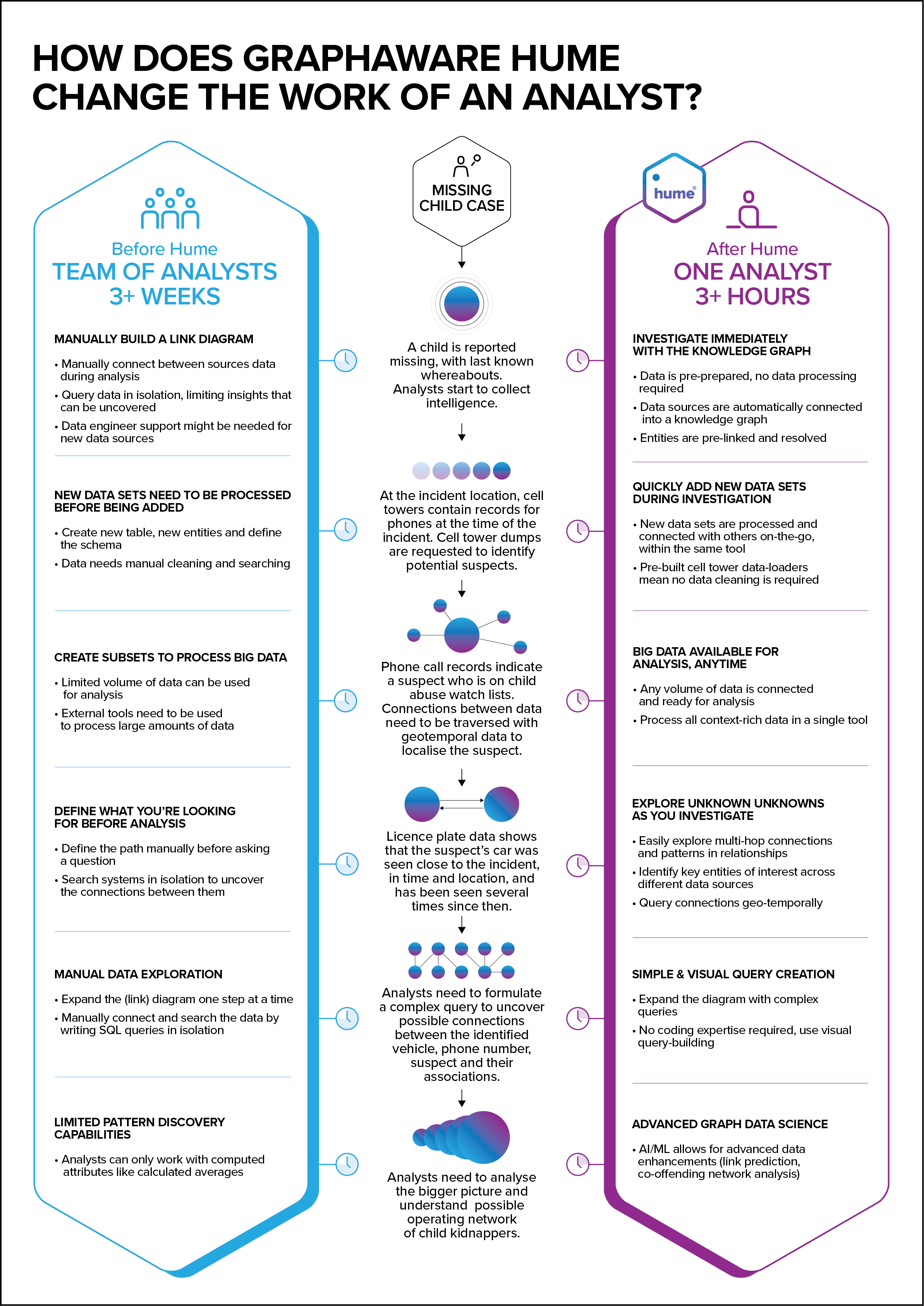
How does GraphAware Hume change an intelligence analyst’s work when solving crime?
It can cut down their work from 3 weeks to 3 hours, because analysts can:
- Investigate Immediately
- Add new data sets on-the-go
- Analyse big data, anytime.
- Explore unknown unknowns
- Create queries simply and visually
- And leverage advanced graph science paired with artificial intelligence or machine-learning
Take a look at the infographic below for a real-world example of how a police analyst’s work changes thanks to GraphAware Hume – by leveraging the power of graph technology throughout the stack.