
At its core, military intelligence analysis is the work of turning incomplete information into an understanding of a nation’s adversaries and threats. It’s a discipline as old as human conflict itself. While its fundamental purpose has endured, the practice has evolved enormously over the centuries.
Historically, the constraint was scarcity of data. Scouts, spies, intercepted correspondence, and later intercepted signals: military intelligence was about forming a narrative from limited information.
Today the problem has largely reversed. Defence organisations now have access to an overwhelming volume of information: HUMINT (from human sources), SIGINT (from intercepted signals and communications), OSINT (from publicly available information), GEOINT (from satellite and geospatial data), plus cyber sources, financial data, company records, supply chain information, and a growing set of commercial and public datasets. The problem has shifted from finding enough information to making sense of too much information from many fragmented sources.
Threats and adversaries have grown more complex too. Analysts today need to understand state and non-state actors, hybrid threats, disinformation campaigns, and risks in their supply chains and critical infrastructure.
These are exactly the kinds of problems no single intelligence source can answer on its own. A company registry might reveal who owns something, but that only makes sense once it’s combined with financial data showing funding relationships, OSINT showing associated people, GEOINT showing what a facility is actually being used for, and SIGINT or HUMINT confirming what’s happening on the inside.
The analyst’s job is to work out how those fragments fit together and how much confidence to place in the resulting picture. This involves five distinct challenges, and skipping any one undermines the rest.
Fragmentation: why a single source rarely tells you anything
A company registry lists the director of a firm under investigation. On its own, that’s just a name on a form. Satellite imagery, held in a different system, shows a warehouse the same firm owns. A financial transfer, tracked in a third system, links back to the director personally. Each record sits in a different system, each serving a different intelligence discipline.
Nothing inherently links the director’s name, the warehouse, and the transfer into a connected intelligence picture. An analyst working in the registry system may have no reason to search a geospatial database unless they already suspect a connection exists. Yet the most valuable connections are often the ones nobody knew to look for.
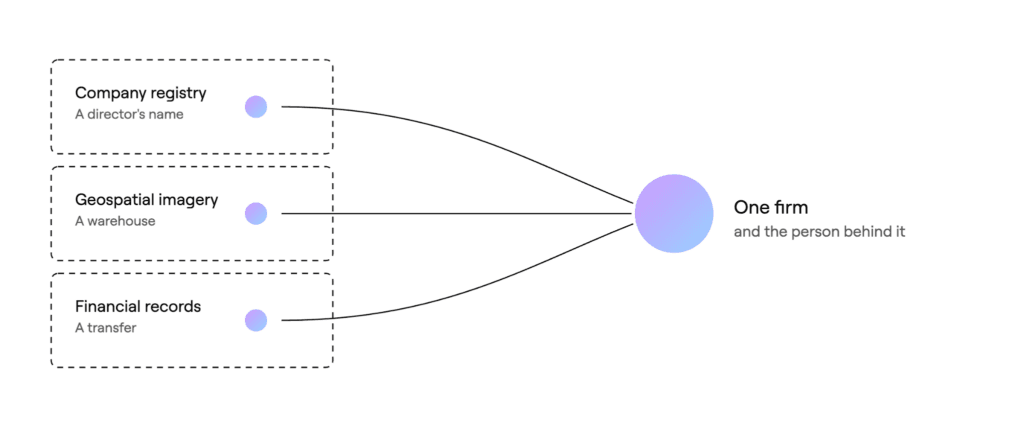
Sometimes that fragmentation is simply a consequence of how the systems were built. And sometimes it’s deliberate obfuscation. An adversary may use a different channel for each part of an operation, or deliberately compartmentalise activity to prevent any one analyst or team from seeing the whole picture.
Resolution: the same entity, described five different ways
Even once two pieces of information sit side by side, they don’t always look like they belong together. A HUMINT report might identify someone by name. A SIGINT intercept might contain only a phone number. An OSINT source might use an alias. A financial record might list a company under a slightly different registered name. Each record describes part of the same real-world entity, but nothing in the raw data necessarily makes that connection explicit.
This challenge is known as identity resolution, or entity resolution: the process of recognising that multiple records actually refer to the same real-world person, organisation, location, or thing. Getting entity resolution wrong in either direction has consequences. A false match can cause analysts to associate an innocent or unrelated person with activity they were never involved in, wasting investigative time and potentially distorting the intelligence picture. A missed match has the opposite effect: an alias, phone number, company, or other identifier belonging to a known actor may continue to appear unrelated, preventing analysts from seeing the full pattern of activity.
Every new dataset added to the picture makes this harder to get right, not easier, unless something is actively holding those identities together as new information arrives.
Provenance: knowing why to trust a connection, not just that it exists
Showing that two things are connected isn’t enough on its own. An analyst also needs to understand the evidence behind a connection: where it came from, which source reported it, how reliable that source has been, when it was observed, and whether other sources corroborate it.
That context matters because two connections can look identical in a network, but rest on very different evidence. One might be inferred from a single low-confidence source, while another may be confirmed by two independent, high-confidence sources. The two don’t deserve the same weight in an intelligence assessment but, if their provenance isn’t preserved, the distinction disappears.
Analysis: what happens once the data is finally together
Bringing the data together is only half the job. Connected data still has to be interrogated, explored, and analysed.
An analyst might trace a chain of ownership through several layers of shell companies, map relationships between organisations and the people between them, or spot shared infrastructure that ties two separate cases together. These insights do not emerge simply because the underlying data has been connected. They depend on the analyst being able to ask questions of it, and follow relationships across the intelligence picture.
This is where much of the analytical value is created. Analysts need to be able to form hypotheses, follow leads, test assumptions, and turn patterns into a shared understanding of the intelligence picture. Simply visualising connected data is not enough; the value comes from being able to interrogate it.
Timeliness: an accurate picture that arrives too late
In military intelligence analysis, an accurate picture that arrives late is often as dangerous as an incorrect one. A target relocates, a network changes how it communicates, a threat that was building three weeks ago may already have moved on and become harder to trace. If the connected picture takes days to catch up with new intelligence, analysts end up working from where things stood when it was last built, rather than where things stand now.
That changes what “fast enough” actually means. It’s not about shaving time off a report. It’s about whether the picture comes together while the opportunity to act on it still exists.
A graph-native foundation is built for exactly this
As the number of intelligence sources grows, so does the burden of connecting them. Analysts have more systems to search, more records to correlate, and more opportunities for important relationships to remain hidden across organisational and technical boundaries.
A graph-native approach changes how that complexity is handled. People, organisations, assets, events, and the relationships between them are represented in a single connected model. Provenance and confidence can travel with those relationships, preserving not only what is connected, but why the connection exists and how much weight it should carry. New sources can then contribute to an existing intelligence picture rather than simply creating another place for analysts to look.
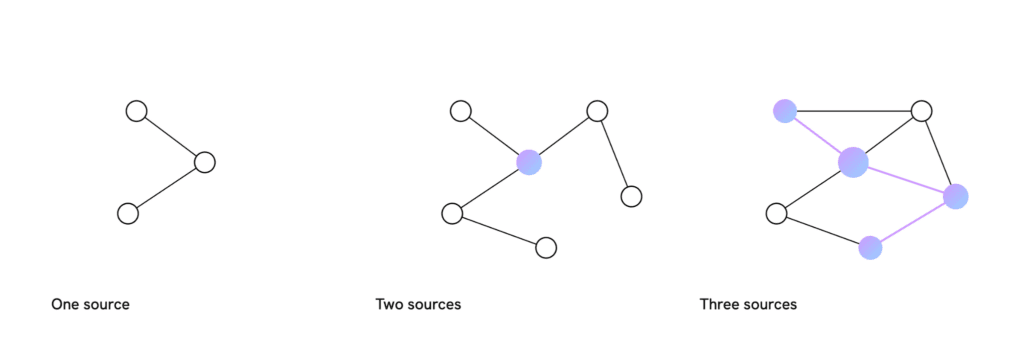
GraphAware Hume is built specifically for teams working with exactly this kind of complex, multi-source data analysis. Data is ingested, stored, modelled and explored as a connected network, and supports the process of resolving a name, a number, and an alias to the same underlying entity, rather than leaving each analyst to work it out independently, case by case, from scratch.
A graph-native core means that as data volumes grow and networks get denser, the platform becomes more powerful, not less. Complexity stops being the constraint and becomes a strength. The same foundation lets an analyst interrogate those connections once they’re made, not just view them, and keeps the intelligence picture current as new information arrives, rather than being reviewed against something already out of date.
What this looks like in practice
A cyber defence organisation working on national security ran into the same pressure: disconnected sources, fast-moving threats, and teams working from different versions of the same intelligence picture. It needed to pull open-source and commercial intelligence into one collaborative view that analysts across different teams could work from together, rather than each team holding its own version of events, and used GraphAware Hume to do it.
Hume Orchestra keeps that picture continuously maintained as new intelligence arrives, rather than analysts working from something that’s already stale. Analysts can build their own advanced queries rather than being boxed into fixed workflows, and navigate the data in both directions, from a known indicator out to related activity, or from a pattern of activity back to what’s driving it, to connect similar attacks through shared indicators, malware, or known associates.
What made the real difference for the cyber defence organisation was connecting strategic and tactical levels of intelligence into the same picture: the top-down view of national security priorities alongside the bottom-up detail of specific tactics and indicators, instead of two separate conversations that never quite met. Work that used to take a week now takes a day, done by a small team supporting a much larger set of stakeholders.
A connected intelligence picture
Every challenge discussed here comes back to the same question: can analysts build and maintain a coherent intelligence picture as the situation changes, and can they understand the evidence well enough to trust the conclusions they draw?
Fragmented sources, unresolved identities, hidden connections, and unclear provenance all make that harder, especially when an adversary is trying to obscure their activity.
A graph-native approach brings those pieces together without stripping away the context that gives them meaning. Relationships are represented directly, provenance and confidence are preserved alongside them, and analysts can explore how new information changes the wider intelligence picture as it emerges.
GraphAware Hume gives analysts a connected, graph-native picture of multi-source intelligence, built to stay traceable and get stronger as complexity grows, not weaker.
Talk to us about what this looks like for your team. Book a demo.