
GraphAware Hume 3.0 introduced a new direction for the platform: giving analysts greater control over how investigations are organised, executed, and shared.
GraphAware Hume 3.1 builds on that foundation with new capabilities that help teams scale their intelligence analysis.
As deployments grow, teams need confidence that the data they rely on remains stable, analytical workflows remain manageable, and the platform can integrate cleanly into existing operating environments.
GraphAware Hume 3.1 addresses those needs with improvements for developers and administrators, alongside new capabilities that help analysts navigate growing volumes of data and investigative complexity.
Organising Actions with tags
One of GraphAware Hume’s greatest strengths is its flexibility. Every deployment is tailored to an organisation’s analytical workflows, with developers creating custom capabilities to meet their users’ needs.
Many of these capabilities are exposed to analysts through Actions: reusable entry points for running queries, workflows, and integrations with a single click.
As deployments mature, teams often create hundreds of Actions inside GraphAware Hume. Without structure, these growing libraries can become difficult to maintain and slow to navigate in a busy investigation.
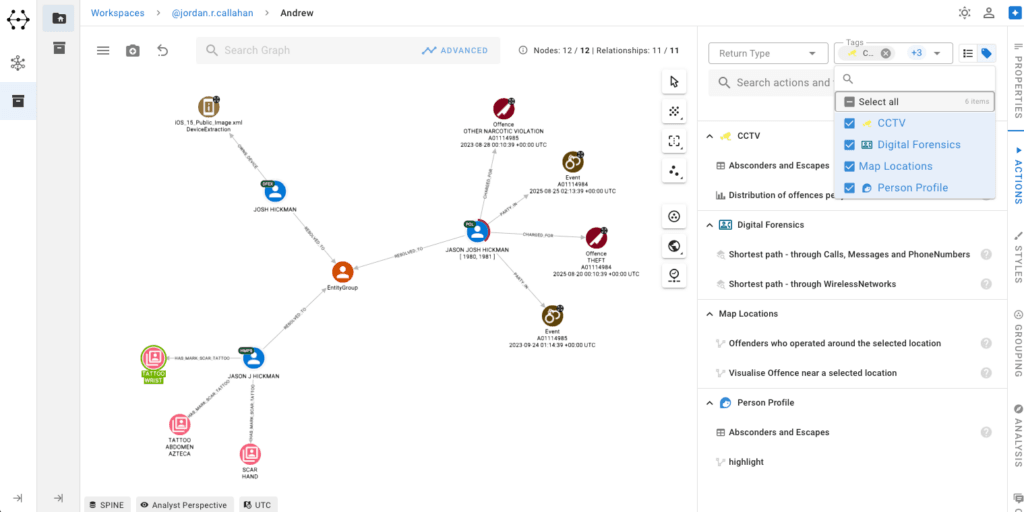
GraphAware Hume 3.1 introduces tags for Actions, helping teams organise them at scale.
Developers can apply reusable tags to categorise Actions, allowing analysts to browse related Actions together, search by tag, and filter large libraries more efficiently.
The result is a cleaner and more structured experience for analysts. Instead of searching through long lists, they can quickly find the Actions relevant to their task and stay focused on the investigation itself.
Tags are implemented as a shared organisational layer across GraphAware Hume and are designed to support future use across additional platform objects, including workflows and styles.
Standard OIDC authentication support
Every organisation has its own approach to identity and access management. Platforms like GraphAware Hume need to align with existing security, authentication, and governance processes.
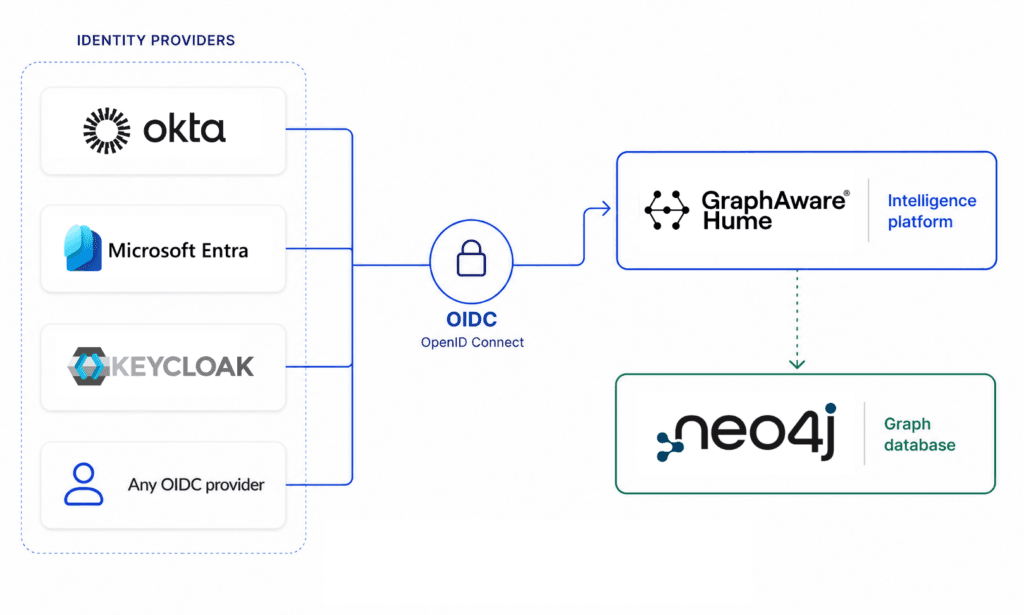
Previous versions of GraphAware Hume supported OIDC authentication via Keycloak, which acted as an intermediary between GraphAware Hume and an organisation’s identity provider.
GraphAware Hume 3.1 removes that requirement.
Customers can now integrate GraphAware Hume directly with any OIDC-compliant identity provider for authentication and single sign-on, without requiring Keycloak as a proxy. This makes it easier to deploy GraphAware Hume in environments where Keycloak is not permitted, while continuing to support organisations that choose to use existing Keycloak-based deployments.
Stable long-term references for Neo4j data
Investigations often span months or years. During that time, data is re-ingested, systems are upgraded, backups are restored, and infrastructure changes.
In mission-critical environments, engineers should be able to carry out essential maintenance without affecting the analyst experience.
GraphAware Hume 3.1 introduces support for using a business identity property as the stable reference for graph elements, rather than relying on Neo4j’s internal database IDs. Organisations can configure which existing node and relationship properties GraphAware Hume should use as the long-term identity for graph elements.
For analysts, this means investigations can continue with confidence. References remain reliable, graphs remain intact, and entities continue to represent the same real-world object even as the underlying platform evolves.
Dark mode is here
You asked, and we listened.
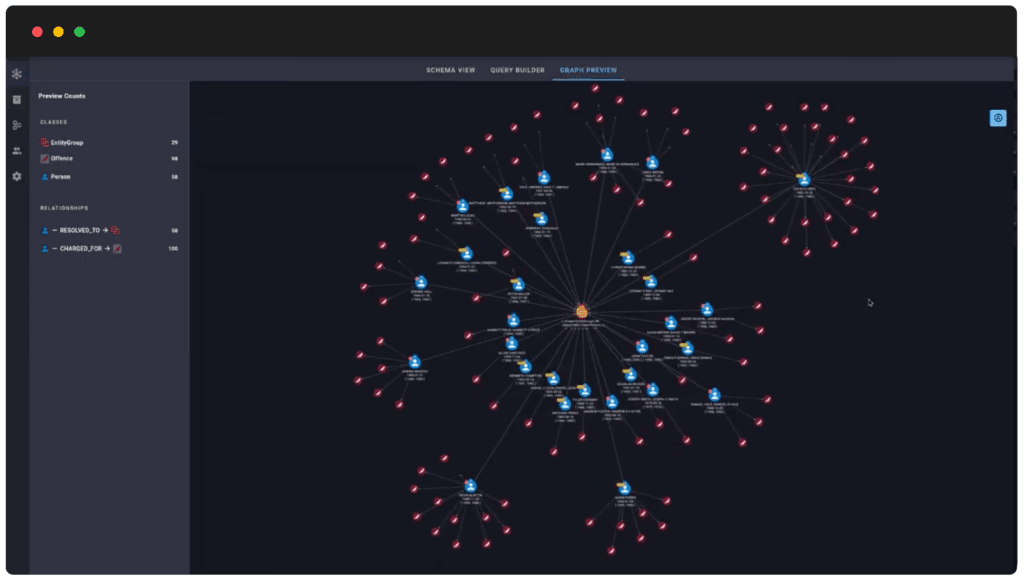
GraphAware Hume 3.1 introduces dark mode, providing analysts with an alternative interface theme for extended analytical sessions and low-light working environments.
Whether you’re reviewing a visualisation, exploring a graph, or working through a complex investigation, you can now choose the interface that works best for you.
Other improvements
GraphAware Hume 3.1 also includes a number of smaller enhancements across Orchestra, entity exploration, and geospatial analysis, including:
- Python packages can now be installed from a local Orchestra folder, making it easier to install custom private Python libraries in secure environments, including deployments without internet access or with strict library installation controls.
- Grouping is now available in the Advanced Expand preview, allowing resolved entities to be displayed as a single grouped node.
- Geospatial Analysis now supports geodesic arcs, rendering relationships on the map as arcs that follow the Earth’s curvature rather than straight lines.
Ready to explore GraphAware Hume 3.1?
GraphAware Hume 3.1 introduces new capabilities that help analysts work more effectively as investigations, data volumes, and analytical workflows grow in complexity.
From tags for Actions and flexible authentication to stable long-term references, this release continues GraphAware Hume’s focus on giving analysts greater control over how investigations are organised and executed.
If you’d like to see the latest capabilities in action, request a tailored demo from our team.