Most intelligence platforms aren’t structured around investigations. Over time, systems, data models, access controls, and integration requirements start to shape how analytical work happens instead.
As a result, analysts spend too much time switching tools, searching across disconnected data, and manually stitching together context that should already be connected.
That’s the gap GraphAware Hume is designed to close. And with GraphAware Hume 3.0, the gap becomes even smaller.
This release isn’t just about new capabilities. It reflects a shift towards a more analyst-led approach to intelligence analysis, where investigations, not systems, define how work gets done.
To understand what this shift looks like in practice, we spoke with Miro Marchi, our Head of Product, and Christophe Willemsen, our CTO. Their perspectives reflect both sides of the problem: what analysts are dealing with today, and how GraphAware Hume is being shaped to support them.
Where analysis breaks down today
Most analytics teams don’t lack data; they struggle to turn it into something useful.
“Analysts still operate across a fragmented landscape of systems,” explains Chris. “They spend a lot of time searching, switching between tools, and stitching information together manually.”
That fragmentation shows up at every stage of the analysis workflow. Searches have to be repeated across systems. Connections between entities are mapped by hand. Collaboration depends on exporting and sharing work that quickly loses context.
“Every breakdown happens at the seams,” says Chris. “Between systems, people, and steps in the workflow, analysts end up acting as the bridge.”
Those workflow inefficiencies don’t just slow investigations down. They create gaps in visibility and coordination that adversarial actors can actively exploit.
“Criminals are acutely aware that gaps exist between systems,” Chris explains. “They exploit fragmentation strategically, operating across jurisdictions and data silos, knowing that no single analyst has the full picture in front of them.”
Solving that problem isn’t just about connecting more systems or exposing more data. It requires changing the way analytical work itself is structured in the first place. The investigation needs to be the organizing principle around which data, collaboration, and analysis are brought together.
Shifting the model: from system-led to investigation-led
One of the key shifts behind GraphAware Hume 3.0 came from a simple observation.
“The unit that drives everything an analyst does is the investigation,” explains Miro. “Not the graph, not the data model. Every conversation we had with analyst teams on every field visit pointed to the same thing.”
That might sound obvious, but it has major implications for how a platform is designed.
Earlier versions of GraphAware Hume were structured around the graph itself, focused on the domain or use case. That made sense from a data perspective, but it didn’t fully match how analysts think.
“Analysts shouldn’t have to organize their work around data structures,” says Miro. “Their work revolves around the investigation, the questions they need to answer, and the hypotheses they need to test. Graphs are a powerful way to do that.”
That shift changes how GraphAware Hume supports intelligence analysis. Rather than simply providing a way to explore connected data, it’s evolving into an environment where analysts can organize and carry out their investigations.
Creating a shared investigation environment
This is where Workspaces come in. Not as a standalone feature, but in response to a gap in how analytical work was organized.
“Before Workspaces, even inside the product, work was still scattered,” says Miro. “You had visualizations in one place, files in another, snapshots somewhere else. There wasn’t a clear way to bring it all together. Workspaces change that.”
Workspaces give analysts a dedicated space to organize everything related to an investigation. Data, visualizations, notes, and context all sit together in one location.
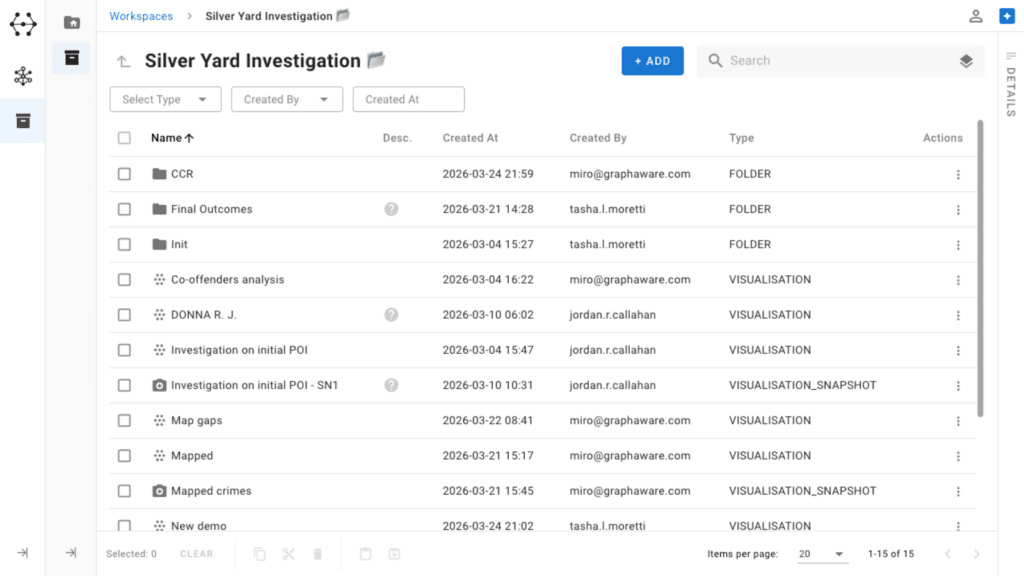
“You open your Workspace and the full picture is there,” says Chris. “You spend less time navigating tools and more time actually analyzing.”
Workspaces also reflect how teams collaborate in practice.
“Investigations are not done by one person,” says Miro. “You have leads, you have people working on different lines of inquiry, and then you bring everything together.”
Instead of passing work between systems, teams can now operate within a shared environment that reflects the investigation as it evolves.
“People can contribute and pick up where others left off,” says Chris. “You remove a lot of the friction that used to be there.”
Instead of investigations existing across disconnected tools and individual analysts’ notes, the Workspace becomes a living shared asset that the team can build around together.
At the same time, control remains simple and explicit.
“We deliberately avoided overcomplicating sharing,” Miro explains. “If you have access to a Workspace, you can see everything in it. If something needs to be restricted, it belongs in a different space.”
That clarity matters in intelligence environments, where investigations often involve sensitive information, tightly controlled access, and teams working across different operational boundaries.
Making complex data easier to work with
Alongside Workspaces, GraphAware Hume 3.0 introduces smart entity resolution, reducing a layer of complexity that previously made connected analysis harder to navigate.
In intelligence environments, the same person, organization, or device can appear across multiple systems and records. Connecting those records accurately is essential for building a reliable intelligence picture, but it also creates technical complexity underneath the surface.
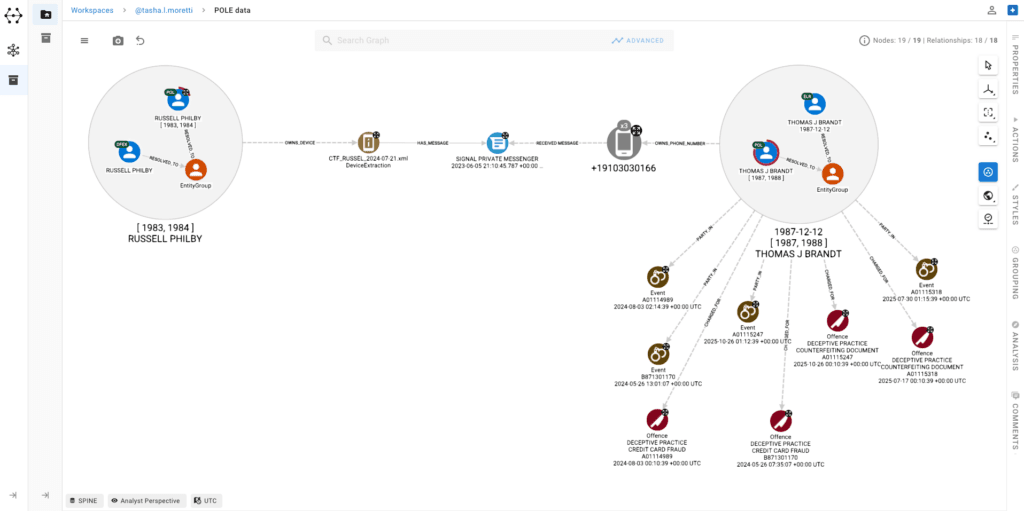
Behind the scenes, GraphAware Hume uses a data model designed to support governance, traceability, and flexibility across those connected records. But that complexity shouldn’t sit with the analyst.
“The data model is there for a reason,” says Miro. “Analysts shouldn’t need to think about how records are structured to do their job.”
GraphAware Hume now handles that complexity behind the scenes, so analysts can focus on the investigation itself.
“The analyst still needs visibility into where information comes from,” says Miro. “What they shouldn’t need to manage themselves is the technical complexity underneath how those records are connected.”
The aim is simple: keep the power of graph-powered intelligence analysis without exposing unnecessary technical complexity to the user.
What does analyst-led actually mean in practice?
This is where the broader direction becomes clearer. In many organizations, analysts still depend on engineering teams to prepare and integrate data before they can properly work with it. That slows investigations down.
“Data engineering can too often become a bottleneck,” says Miro. “Analysts have data they want to explore, but they can’t move forward and start investigating it until another team has integrated it into the knowledge graph.”
That delay has real consequences.
“Sometimes the missing piece of an investigation is just a file that’s arrived,” Chris explains. “If you can’t use it straight away, you lose time. And in high-stakes investigations, that time matters.”
Reducing that dependency, where it makes sense, is part of GraphAware Hume’s longer-term direction.
The aim is to give analysts more freedom to explore and assess data as they work. To test ideas, follow leads, and build understanding earlier in the investigative process.
“We want analysts to be able to work with data directly,” says Miro. “To explore it and decide if it’s useful before involving engineering.”
That doesn’t remove the role of engineering teams or bypass governance requirements. But it does change how analysis and technical teams work together, giving analysts more flexibility without losing structure or control.
Where GraphAware Hume is heading
GraphAware Hume 3.0 builds on what’s already there, moving it forward with a clear direction.
“Organizations that have been using GraphAware Hume as a graph analysis tool will increasingly find themselves working in a more complete investigation environment,” says Chris. “The day-to-day experience moves from running queries and building visualizations to actually running investigations end to end in one place.”
That means bringing more of the analytical workflow into one place, while keeping investigations connected, collaborative, and fully contextualized as they evolve.
Future developments will build on this foundation by making it easier to integrate data from different sources, track how analysis evolves, and support collaboration without sacrificing control or clarity.
AI will also become part of this wider analyst workflow, but in a way that keeps human judgement at the center of the process.
“AI should assist the analyst, not replace them,” says Miro. “It can help navigate data and answer questions, but the analyst stays in control.”
One upcoming capability, Document Intelligence, will focus on helping analysts work more effectively with unstructured investigation material inside Hume Workspaces. Analysts will be able to upload documents and ask questions in natural language directly within their Workspace.
“You’ll be able to trace responses back to the original documents,” Miro explains. “That’s critical for trust and verification.”
Closing the gaps in intelligence analysis
Criminals exploit the gaps that arise when work is fragmented across tools. GraphAware Hume is built to close those gaps, making the investigation itself the center of the analytical workflow.
The teams using it aren’t running experiments; they’re running active investigations under real-time pressure, where gaps in the picture have real consequences. That’s the standard shaping every decision about GraphAware Hume evolves.
See GraphAware Hume in action