
What is linked data?
Linked data is an approach to publishing and connecting structured data so that information about entities and concepts can be identified, referenced and linked across datasets.
The term has a specific meaning. Linked data is based on a set of web standards and principles, including using URIs to identify resources, making those resources accessible over HTTP, providing useful information when they are accessed, and linking them to other resources. It is data that can be connected across organisational and system boundaries rather than remaining meaningful only within the application where it was originally created.
For intelligence teams, this matters because investigations frequently require information from different sources to be considered together.
A company record might identify an organisation by one identifier. A financial dataset might use another. A sanctions list may contain a different representation of the same entity. Linked Data provides a way to identify resources consistently and connect related information across datasets.
The important idea is not simply that data is “linked”. It is that the links are explicit, machine-readable and designed to work across sources.
Why does linked data matter for intelligence?
Intelligence analysis often depends on combining information that was collected for different purposes and stored in different systems.
Consider a financial investigation involving a suspected network.
One source identifies a company and its directors. Another records transactions involving the company’s accounts. A third contains regulatory information about its ownership. A fourth may contain information about an associated organisation in another jurisdiction.
Individually, each dataset provides only part of the picture.
When information can be connected through consistent identifiers and relationships, analysts and systems can explore those sources together.
This can support questions such as:
- Which organisations are connected to this individual?
- Which datasets contain information about this company?
- What other entities are associated with the same identifier?
- Which sources provide information about this relationship?
- How does information from one dataset connect to information held elsewhere?
Linked data does not answer these questions automatically. Its value is in making the underlying information easier for different systems to connect, discover and reuse.
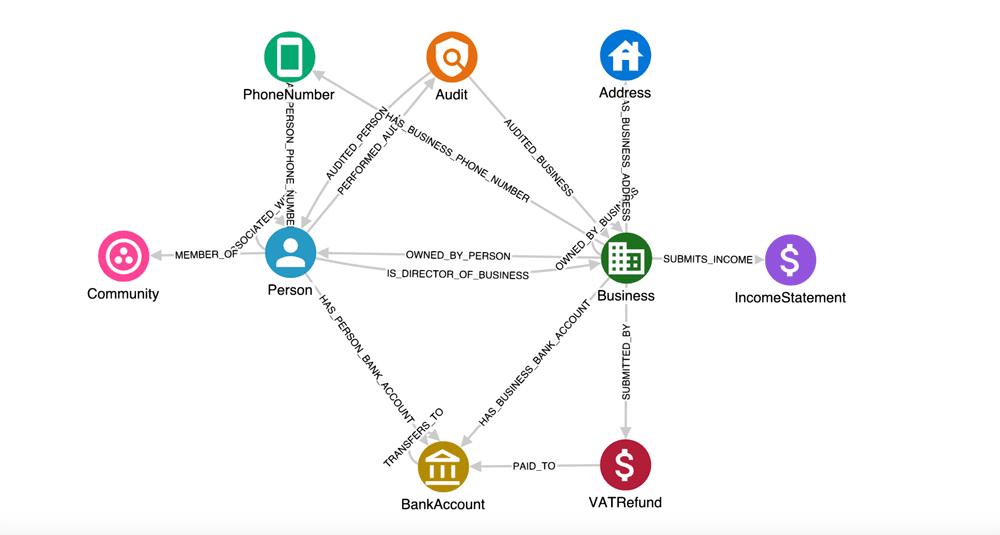
How does linked data work?
Linked data uses web standards to identify resources, describe relationships between them and make connections discoverable.
Three concepts are particularly important.
URIs
A URI, or Uniform Resource Identifier, provides an identifier for a resource such as a person, organisation, location or concept.
The important property is that the identifier can be referenced beyond the boundaries of a single database.
For example, an organisation could have a URI that is referenced by several datasets rather than being represented only by a local database ID.
This provides a common way for different systems to refer to the same resource.
RDF
The Resource Description Framework (RDF) provides a standard data model for representing information as statements.
An RDF statement consists of three parts:
Subject → Predicate → Object
For example:
Company A → owned by → Person B
or:
Person B → director of → Company A
These statements can be combined with statements from other datasets, allowing information to form a connected network.
RDF is a W3C standard for representing information on the web and provides the graph-based structure used by many linked data applications.
SPARQL
SPARQL is a query language for RDF data.
It allows systems to query patterns and relationships across RDF datasets rather than simply retrieving individual records. It can also support queries across diverse data sources where the relevant infrastructure is available.
For example, a query could identify organisations connected to a particular person through a defined relationship, or combine information about the same resource from multiple datasets.
Linked data and the web
Linked data emerged from work around the Semantic Web, including principles proposed by Tim Berners-Lee for making data on the web more interconnected and machine-readable.
The objective is not to create one central database containing all information. Instead, different organisations can publish data using shared standards and identifiers so that applications can discover relationships between resources across datasets.
This makes linked data particularly relevant where information needs to be shared, reused or integrated across organisational boundaries.
For example, one public dataset could identify an organisation using a URI that is also referenced by another dataset. Applications can then follow those links to discover additional information about the same resource.
Linked data vs graph technology
Linked data and graph technology are closely related, but they are not the same thing.
Linked data refers to principles and standards for publishing and connecting data, particularly on the web.
Graph technology is a broader category covering technologies for modelling, storing, querying, visualising and analysing connected data.
RDF is a graph-based data model used in linked data. Other graph technologies use different models, including property graphs.
This distinction matters because not every graph database implements linked data, and linked data does not depend on a particular graph database.
For example, GraphAware Hume uses graph technology and knowledge graphs to connect fragmented information for intelligence analysis. That makes it relevant to the broader problem of connecting data, but GraphAware Hume is not simply a linked data platform. The concepts overlap around connected information but address different requirements.
Linked data vs graph databases
A graph database is a technology for storing and querying connected data.
Linked data is an approach to publishing and connecting data using web standards.
They can be used together, but they are not interchangeable.
An organisation might use a graph database to store and analyse a connected dataset internally. Another might publish RDF data so that external systems can discover and connect to its datasets.
The data models can also differ. RDF represents information as subject-predicate-object statements, while property graphs typically represent nodes and relationships that can carry their own properties.
The choice depends on what the organisation needs to do with its data, how it needs to exchange information, and which standards its other systems support.
Linked data vs knowledge graphs
A knowledge graph is a structured representation of entities and their relationships that adds context and meaning to connected information.
Linked data can be used to publish or connect information within a knowledge graph, but the concepts are not synonymous.
A knowledge graph is concerned primarily with representing connected knowledge and meaning.
Linked data is concerned with identifying, connecting and making data discoverable across sources using web standards.
A knowledge graph can use linked data principles, RDF and shared vocabularies, but knowledge graphs can also be built using other graph technologies and data models.
For intelligence teams, the distinction is useful: linked data can support interoperability between sources, while a knowledge graph provides a connected representation that can be explored and analysed.
Linked data in intelligence investigations
Linked data is most useful when information needs to be connected across datasets or organisational boundaries.
Connecting organisational information
An investigation may involve company registries, sanctions data, financial records and internal intelligence.
Shared identifiers and linked representations can help systems determine where different datasets refer to the same resource and connect information about it.
Supporting cross-border investigations
Different jurisdictions may publish information using different systems, identifiers and data structures.
Common standards for identifying and describing resources can support interoperability when information needs to be brought together across those boundaries.
Connecting public and internal information
Investigators may need to combine internal intelligence with external sources.
Linked data can make externally published information easier for systems to discover and connect to other datasets when those sources use compatible standards and identifiers.
Improving information discovery
Linked relationships allow systems to move beyond retrieving an isolated record.
An application can follow relationships between resources to discover related information, potentially revealing additional sources and context that would be difficult to identify through a search of a single dataset.
Linked open data
Linked open data is linked data that is made available under an open licence so that others can access, use and redistribute it subject to that licence.
The distinction is important:
Linked data doesn’t necessarily mean data is publicly available.
An organisation can use linked data principles and technologies within a controlled environment. Linked open data specifically concerns data that is openly published and reusable.
This makes linked open data particularly relevant to public-sector information, research datasets and other sources intended for reuse across organisations.
The five-star model
Tim Berners-Lee proposed a five-star scheme for describing how open data is published in ways that make it increasingly reusable and connected.
The progression moves from making data available on the web under an open licence, through using structured and non-proprietary formats, to using web standards and linking data to other datasets.
The fifth star represents data that links to other data, providing additional context and enabling further discovery.
The model is best understood as a guide to the openness and interoperability of published data rather than a measure of overall data quality.
What are the benefits of linked data?
Improved interoperability
Linked data uses common standards for identifying and describing information, helping different systems work with related data.
Easier data discovery
Explicit links between resources allow applications to discover related information across datasets.
Better data integration
When different sources use compatible identifiers and vocabularies, information can be connected without requiring every dataset to use the same underlying system.
Greater reuse
Data published using open standards can be reused by different applications and organisations, subject to access and licensing conditions.
Richer context
Following relationships between resources can provide additional context around an entity or concept rather than treating each record in isolation.
These benefits depend on the quality of the data, identifiers, relationships and vocabularies being used. Linked data does not automatically resolve duplicated entities, inaccurate information or inconsistent source data.
What are the limitations of linked data?
Linked data is not a replacement for every form of data integration.
Creating useful links requires appropriate identifiers, relationships and vocabularies. Where different sources represent the same entity differently, additional work may be required to establish whether they refer to the same underlying resource.
There are also practical considerations around:
- Data quality
- Identity matching
- Vocabulary alignment
- Access controls
- Governance
- Provenance
- Licensing
For intelligence organisations, provenance and security are particularly important. Being able to connect information is useful only when analysts can understand where that information came from, how it was established and whether they are authorised to access it.
How does linked data relate to GraphAware Hume?
GraphAware Hume connects fragmented data sources into a connected intelligence picture, allowing analysts to explore relationships between entities such as people, organisations, accounts, devices and transactions.
This addresses a closely related problem to linked data: connecting information that would otherwise remain separated across systems.
The distinction is important, however. GraphAware Hume is designed around graph-powered intelligence analysis, rather than around the specific web-publishing standards that define linked data.
For analysts, the practical outcome is the ability to work with connected information in an analytical environment, while the underlying graph technology provides the structure needed to explore relationships, analyse networks and understand how information fits together.
Linked data and the future of connected information
Linked data remains relevant wherever information needs to be shared, reused and connected across organisational or system boundaries.
Its principles provide a common foundation for identifying resources, describing relationships and connecting datasets. Other technologies, including graph databases and knowledge graphs, can build on similar ideas while addressing different analytical and operational requirements.
For intelligence teams, the enduring value is straightforward: information becomes more useful when systems can understand not just the data itself, but how different pieces of information relate to one another.
FAQs
What is an example of linked data?
A simple example would be a dataset identifying a company using a URI and linking that company to a director, industry classification or another resource that is also identified using a URI. Other datasets can then reference those same resources and connect their own information to them.
Is linked data the same as a knowledge graph?
No. Linked data is an approach to publishing and connecting data using web standards. A knowledge graph represents entities and relationships in a structured, meaningful way. A knowledge graph can use linked data principles, but it does not have to.
Is linked data the same as a graph database?
No. A graph database is a technology for storing and querying connected data. Linked data is an approach based on web standards such as URIs and RDF. A graph database can support linked data, but the two terms describe different things.
Does linked data require RDF?
RDF is the standard data model most closely associated with linked data and is central to the formal linked data ecosystem. However, linked data is not simply a file format or database technology. It also involves principles around identifiers, HTTP access and linking resources.
What is RDF used for?
RDF provides a standard way to represent statements about resources and their relationships using subject, predicate and object. This allows information from different sources to be combined and queried as connected data.
What is SPARQL used for?
SPARQL is a query language for RDF data. It allows systems to query patterns and relationships within RDF datasets and can support queries across different data sources.
Is linked open data the same as linked data?
No. Linked open data is linked data that is published under an open licence for reuse. Linked data itself does not have to be publicly accessible.
How can linked data help intelligence analysis?
Linked data can help connect information across datasets and organisational boundaries, making relationships between entities easier for systems to discover and reuse. In intelligence environments, this can support the integration and discovery of information from multiple sources.