
GraphAware Hume 3.0
Built for the reality of intelligence work
Request a demo
Intelligence analysis isn’t linear. Data is fragmented, hypotheses evolve, and teams work across files, systems, and sources to find clarity.
GraphAware Hume 3.0 is built for that reality.
It’s a graph-powered intelligence analysis platform designed for mission-critical environments. It creates a connected view of intelligence, helping analysts explore relationships, follow leads, and uncover patterns across complex, multi-source data.
Workspaces are a new way to manage your analysis in GraphAware Hume.
They give analysts a dedicated space to organise their work, structure their projects, and collaborate with colleagues.
Workspaces bring the visualisations, files, and analytical outputs related to a line of enquiry in a tidy, manageable way.
Keeping these elements connected helps analysts maintain context and stay organised as analysis develops and new findings emerge.
Analysts can create and share new Workspaces whenever they’re needed. That could be for a new case, investigation, project, or lead of enquiry.
Each can have its own space, making it easier to move between analyses without work becoming mixed or difficult to track.
Workspaces support controlled
collaboration through clearly defined
and easy-to-manage permissions.
Analysts can share their work, invite contributors, add comments and snapshots, and collaborate freely while maintaining clear ownership.
Intelligence analysis often means working with data from many different systems. As more sources are integrated, complexity increases, making it harder to understand how data relates and how best to query it.
GraphAware Hume 3.0 introduces two key improvements that make this process easier to manage and multi-source graphs easier to navigate.
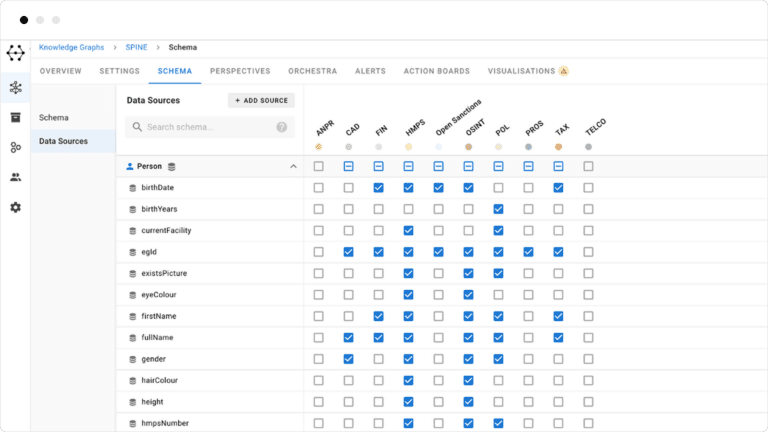
GraphAware Hume 3.0 makes
data source information visible
in the schema view.
Developers can partition schema classes, relationships, and attributes
by data source, making it easier
for both developers and analysts
to understand how different
datasets contribute to the
wider intelligence picture.
The result is a clearer data
model and more confidence
when querying connected data.
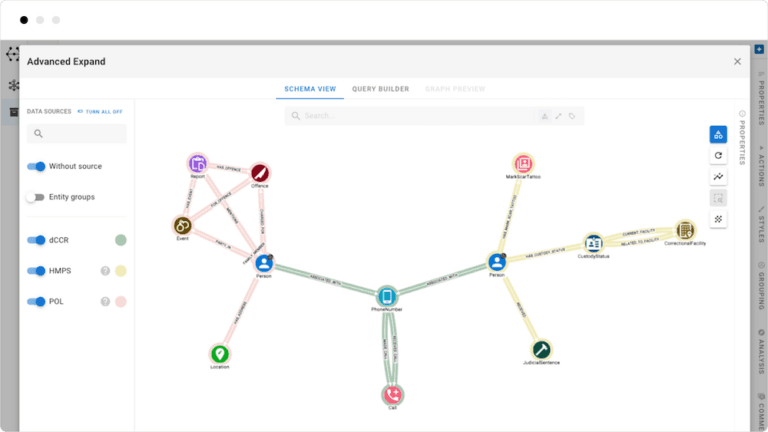
The same real-world entity often appears in multiple systems. A person, organisation, or location may exist in
several datasets, each represented separately.
GraphAware Hume links these records using entity groups, preserving source data while connecting related entities.
In GraphAware Hume 3.0, analysts can query and explore data across entity groups more intuitively, without having to manually account for them. This makes the graph easier to navigate and reduces the risk of errors.
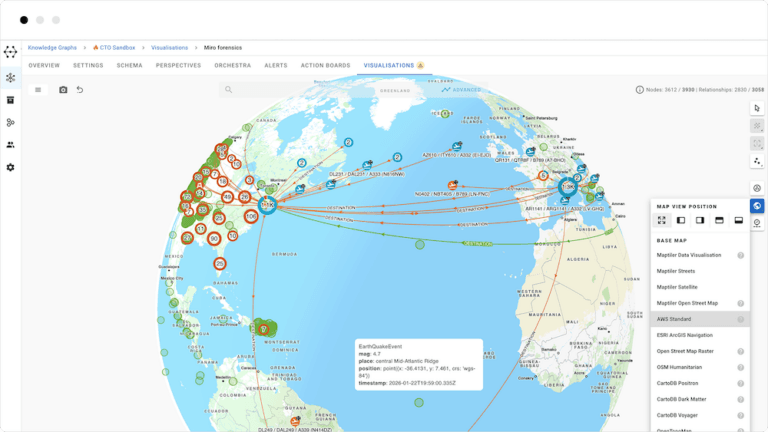
Multiple geospatial base layers can now be configured, including vector and raster maps.
Analysts can switch between map styles on demand, choosing the view that best supports their analysis.
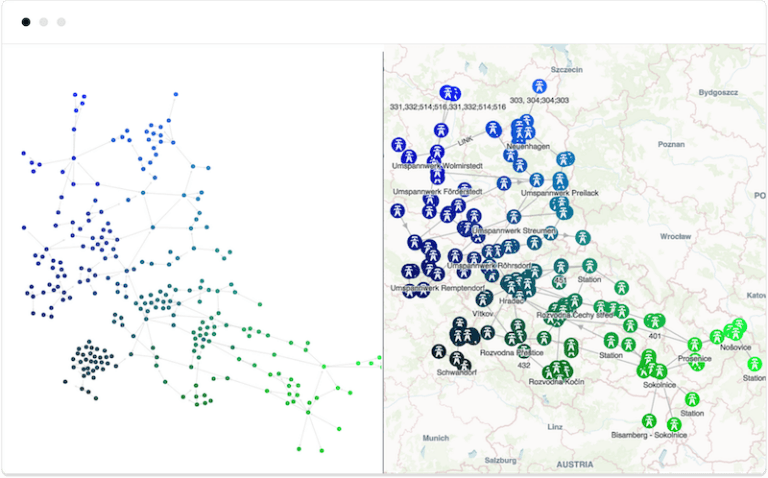
A new geo-influenced layout incorporates geospatial location into graph positioning.
This makes it easier to connect network structure with real-world geography.
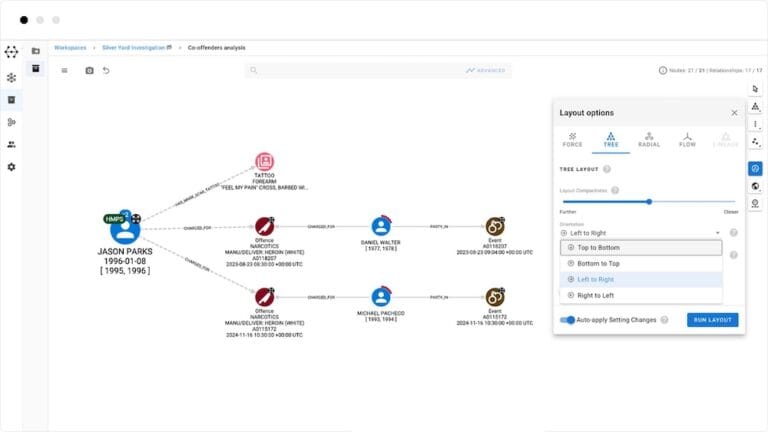
New layout controls allow analysts to align, arrange, and distribute nodes into cleaner, more structured views.
Dense geospatial views are also easier to read, with improved visibility for clustered nodes.
GraphAware Hume 3.0 is designed for the reality of intelligence work, giving analysts the structure and control they need to manage complexity with confidence.
In this webinar, our CTO and Head of Product explore five common intelligence analysis challenges, and explain how GraphAware Hume 3.0 offers practical ways to solve them.
This blog post explores what’s new in GraphAware Hume 3.0 and shares how Workspaces change the way analysts manage their work.